 blog
blog
Booking Apps With Verified Professional Reviews
Table of Contents
- Why Verified Professional Reviews Matter in Booking Apps
- Best Booking Apps for Beauty Professionals With Verified Reviews
- How to Find a Trusted Beauty Professional on Booking Platforms
- What to Check Before Booking an Appointment
- Beauty Appointment Booking Apps: Features That Matter
- Comparing Booking Apps: What Separates Trust From Risk
- Frequently Asked Questions
Last Updated: October 14, 2026
Why Verified Professional Reviews Matter in Booking Apps
Searching for a beauty professional is a decision based on trust.
Verified reviews come from actual clients who booked and completed a service, tied to real transactions rather than anonymous comments, protecting you from fake reviews or inflated ratings.
At Alyry, we've built our platform around this principle, connecting clients with vetted beauty and personal care professionals through verified credentials and authentic client feedback.
Best Booking Apps for Beauty Professionals With Verified Reviews
Most listicles rank booking apps by star rating or feature count, hiding the real question: how a platform verifies that a review came from a real, paying client.
Our Selection Criteria (and Test Dates)
We evaluated booking apps against six criteria in October 2026:
- Review provenance, Does the platform require proof of a completed booking before a review can be published?
- Reviewer identity checks, Is the reviewer's name, email, phone, or payment method confirmed?
- Professional credential verification, Does the app check licenses, certifications, or training, and how often does it re-verify?
- Moderation and dispute process, Can a professional flag a review as fraudulent, and what happens next?
- Review display quality, Are review dates, service tags, and verified-booking badges shown?
- Booking fundamentals, Real-time calendar, automated reminders, self-service booking, transparent pricing.
We weighted review provenance and credential verification most heavily.
How the Major Booking Apps Handle Verification
Alyry, Built around vetted beauty and personal care professionals.
Booksy, Popular with barbers, braiders, and nail technicians.
Fresha, Free for professionals, popular with independent stylists.
Square Appointments, Strong calendar and payment integration.
Vagaro, Popular with salons and spas.
GlossGenius, Aimed at independent beauty professionals.
Squire, Built for barbershops. Reviews are tied to completed bookings, and a stronger client-account requirement reduces (but does not eliminate) duplicate reviews.
What Makes a Review Verified
A verified review comes from a completed booking: the client booked through the platform, the appointment happened, and they left feedback, creating an audit trail confirming the reviewer paid for and received the service.
Verified reviews also typically require identity verification, name, email, or phone, sometimes cross-checked against payment information.
How Review Quality and Recency Affect Your Choice
Not all reviews carry equal weight. A review from last month tells you more about current quality than one from two years ago.
Specificity matters too. 'She listened to what I wanted, explained the process, and delivered exactly what I asked for' is far more useful than 'great service.' Look for platforms that display review dates and prompt clients to explain what they liked or didn't like, this gives you a realistic picture of what booking with that professional will be like.
How to Read a Review Profile Like an Editor
Star averages hide more than they reveal. When you open a professional's profile, scan for these signals in order:
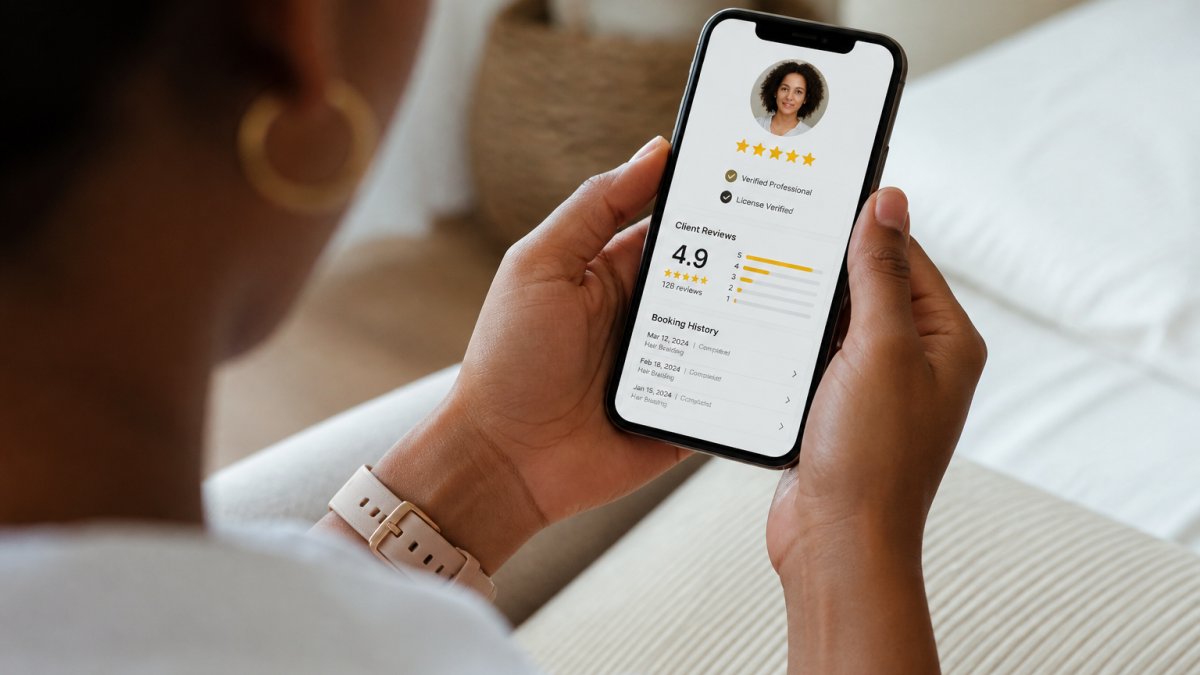
- Volume and spread. A profile with 80 reviews averaging 4.7 stars is more trustworthy than one with 8 reviews averaging 5.0. Small samples are easy to game.
- Recency. Sort by newest. If the most recent review is from eight months ago, the professional may have stopped taking new clients or changed their service.
- Service tags. Reviews tied to a specific service (for example, 'knotless braids' or 'balayage') tell you whether the professional is strong in the service you actually want.
Where Each App Fits Best
- Independent beauty professionals who want strong review integrity: Alyry, Booksy.
- Barbershops and braiders: Squire, Booksy.
- Salons and spas with multiple staff: Vagaro, Square Appointments.
No single app wins on every criterion. The right choice depends on whether you weight review authenticity, credential verification, or booking convenience most heavily.
How to Find a Trusted Beauty Professional on Booking Platforms
Finding a trusted professional starts with the signals that matter: a solid booking history, recent positive reviews, and clear credentials in their specialty.
Filter for the specific service you need, search "locs specialist," not just "braider." Then check how long they've been booking through the platform, how many completed appointments they have, and what recent clients say.
Trust is built on consistency: 100 bookings with steady four-to-five-star reviews beats 10 bookings with all five-star reviews.
What to Check Before Booking an Appointment
Before confirming a booking, verify the professional's credentials, availability, pricing, and booking workflow.
Credential Verification and Professional Background
Look for professionals who list certifications, training, or specialties on their profile. Some platforms verify credentials through third-party checks, a strong signal of transparency.
Ask whether they have training in the service you need, color certification for a colorist, formal training for a makeup artist.
Availability, Pricing, and Booking Workflow
Check availability: some professionals book weeks in advance, others have last-minute slots. Pricing should be clear and upfront, the best apps show the exact price before you confirm, with no surprise fees.
The booking workflow matters too: can you select your service, see the duration, choose a time slot, and get a confirmation and reminders?
Beauty Appointment Booking Apps: Features That Matter
The best booking apps make scheduling easy and reduce no-shows through calendar management, automated reminders, and self-service booking.
Calendar Management and Automated Reminders
A professional's calendar should sync with their schedule so you're never double-booked; real-time availability is essential.
Automated reminders reduce no-shows: a reminder 24 hours before the booking makes clients more likely to show up or cancel in time for the professional to rebook. Look for apps that let professionals set buffer time between appointments, if a stylist needs 15 minutes to clean up, the app should block it automatically.
Guest Screening and Safety Features
Some apps include guest screening: requiring a valid payment method before booking, letting professionals see client reviews before accepting, or enabling them to decline clients with a history of no-shows.
Safety features protect both sides: professionals feel secure with vetted clients, and clients know they're booking with someone vetted by the platform.
Comparing Booking Apps: What Separates Trust From Risk
Most comparisons stop at a feature table, but the features that matter most for verified professional reviews, review authentication, credential checks, dispute handling, are invisible in a checkbox grid.
A Five-Question Trust Audit You Can Run in 15 Minutes
Before you commit to a booking app, answer these five questions. If the app cannot answer them clearly, that is your answer.
- Can a review be posted without a completed booking? If yes, the review pool is not verified. If no, ask what proof the platform requires, a booking record, a payment, or both.
- Is the reviewer's identity confirmed? Email-only confirmation is weak. Phone plus payment method is stronger. Government ID is strongest but rare in this category.
- What happens when a professional disputes a review? A published policy with a review window and an appeals path is a green flag. Silence is a red flag.
- What credentials does the platform actually check? 'Vetted' is a marketing word. Ask: license, certification, insurance, or nothing?
- How often is verification refreshed? A one-time check at signup is weaker than annual re-verification, especially for licensed services like cosmetology.
How Review Verification Actually Works (and Where It Breaks)
Verification is a chain, only as strong as its weakest link.
- Booking linkage. The platform ties the review to a booking record. This is the baseline. Without it, nothing else matters.
- Identity confirmation. The platform confirms the reviewer is a real person, usually via email, phone, or payment method. This stops bots and duplicate accounts.
- Moderation. The platform reviews flagged content and removes reviews that violate policy. This is where most platforms are weakest, because moderation is expensive.
A platform can be strong on booking linkage and weak on moderation, which is why 'verified review' badges vary in meaning: the badge tells you a booking happened, not that the platform polices what happens after.
Credential Verification vs. Review Verification: Two Different Things
These two ideas get conflated constantly, and the confusion costs clients money.
Credential verification is about the professional: are they licensed, trained, or certified for the service they sell?
Review verification is about the client: did this person actually book and receive the service? Evidence is a booking record and a confirmed identity.
Privacy and Consent in Verification
Verification requires personal data, raising questions most comparisons skip.
- What is collected? Identity checks may involve a name, email, phone number, payment method, or in rare cases a government ID. Credential checks may involve license numbers, certificates, or insurance documents.
- How is it stored? Look for a published privacy policy that states retention periods and whether data is shared with third parties.
- Who can see it? Clients should not be able to see a professional's uploaded documents. Professionals should not be able to see a client's payment details beyond what is needed to process the booking.
A professional whose license verification fails on a name mismatch can lose bookings, and a client whose review is removed without explanation loses trust. Good apps publish their policies; weak apps hide behind 'proprietary systems.'
A Comparison Framework You Can Reuse
Use this table as a starting point, then fill in specifics for each app, answering every row with evidence, not marketing copy.
| Criterion | What to Look For | Why It Matters |
|---|---|---|
| Review provenance | Booking record required before review publishes | Confirms the reviewer was a real client |
| Reviewer identity | Email plus phone or payment method confirmed | Reduces fake and duplicate reviews |
| Moderation policy | Published rules, flagging process, appeals path | Determines whether bad reviews get removed fairly |
| Credential verification | License, certification, or training checked and re-checked | Confirms the professional is qualified for the service |
| Verification refresh | Annual or event-triggered re-verification | Keeps credentials current |
| Data handling | Published privacy policy with retention and access rules | Protects both clients and professionals |
| Dispute process | Documented steps and response times | Gives both sides recourse |
| Calendar accuracy | Real-time availability, no double-bookings | Prevents scheduling conflicts |
| Automated reminders | Email, SMS, or push notifications before appointments | Reduces no-shows |
| Transparent pricing | Clear costs shown before booking | Prevents surprise fees |
The Bottom Line on Trust
Trust in a booking app is not a toggle. It is the sum of how the platform handles reviews, credentials, disputes, and data, and how transparent it is about all four. An app that verifies credentials, ties reviews to completed bookings, publishes moderation rules, and explains its data handling deserves your trust.
Frequently Asked Questions
How can I tell whether reviews on a booking app are verified?
Verified reviews typically come from customers who completed a booking through the platform. Look for badges or labels indicating the reviewer booked a service, completion dates, and photos attached to reviews. Platforms that verify professional credentials also display this information prominently. Authentic review systems prevent fake submissions by requiring account history and booking records. Check the recency of reviews, recent feedback is more reliable than older posts. Avoid platforms where anyone can leave reviews without booking proof.
What should I check before booking a beauty appointment through an app?
Verify the professional's credentials, certifications, and years of experience listed on their profile. Read recent client reviews focusing on specific feedback about the service you need. Check their availability and cancellation policies. Review their portfolio or before-and-after photos if available. Confirm the pricing and any additional fees upfront. Look for safety features like guest screening and secure payment options. Ensure the booking workflow is clear and includes appointment confirmation and automated reminders. Contact the professional directly if you have questions about their specialties.
Which booking apps help you find beauty professionals with verified reviews?
Platforms that prioritize verification implement credential checks, identity confirmation, and review authenticity measures. Look for apps that display professional licenses, certifications, and background information. Platforms that prioritize verification require booking completion before allowing reviews. Some apps feature specialist filters, barbers, braiders, colorists, makeup artists, so you can find verified experts in your specific service category. Alyry, for example, connects clients with vetted beauty and personal care professionals across multiple service types. Compare platforms on how they display verification badges and review dates.
What is the best booking app for finding beauty professionals on short notice?
The best apps for last-minute bookings display real-time availability and allow direct booking without lengthy approval processes. Look for platforms with instant booking features, automated appointment confirmation, and clear cancellation policies. Professional services apps that serve your local area tend to have faster availability updates. Calendar management tools that sync across professionals help reduce no-shows. Check whether the app shows same-day or next-day openings for your service type. Verified marketplace platforms often have higher reliability because professionals are accountable through credential verification.