 Listicle
Is There a Better StyleSeat Alternative for Mobile Barbers?
Last Updated: October 30, 2026
Quick Summary
The best styleseat alternative for mobile barbers depends on whether you need a scheduling-first tool or a client marketplace. Test travel buffers, service-area control and deposit handling on a trial account before committing, and compare total cost rather than the headline subscription price.
- Judge each platform on phone-first access, a public booking page, client history, automated reminders and clear payment terms.
- Test travel buffers, service-area control, client addresses and deposit behavior during a real working week.
- Total cost equals subscription plus processing, add-ons and no-show leakage, not the plan price alone.
- Send one booking confirmation and a second reminder the day before to reduce no-shows.
- Export your client list and appointment history before switching platforms to avoid losing records.
Table of Contents
- Why Mobile Barbers Look for a StyleSeat Alternative
- What Mobile Barbers Need From Booking Software
- Top StyleSeat Alternatives Compared
- Booksy vs StyleSeat for Barbers: Which Fits a Mobile Practice?
- Total Cost for Solo Mobile Barbers vs Growing Teams
- Mobile Workflow, Offline Use and Client Booking Control
- Choosing Your Barber Appointment Scheduling Software
- Frequently Asked Questions
Mobile barbers have a booking problem that most salon software was never designed to solve. When you travel to a client's home, a studio apartment or a corporate office, your scheduling tool needs to work from your phone, handle travel time and keep payments simple.
Alyry is a verified marketplace that connects clients with barbers, braiders, stylists, nail technicians and makeup artists.
Why Mobile Barbers Look for a StyleSeat Alternative
A barber who drives to clients needs a schedule that accounts for travel between appointments, a booking page that clients can use from anywhere and reminders that go out without manual follow-up.
The most common reasons barbers start looking elsewhere include:
- Location-based scheduling. Appointments tied to a single shop address do not reflect a route across the city.
- Client communication. Barbers who work alone need automated reminders more than a front desk does.
- Cost as the business grows. A solo operator and a team of three pay very different amounts for the same features.
Watch out: Before switching platforms mid-season, export your client list and appointment history, since a gap in client records can be costly.
What Mobile Barbers Need From Booking Software
Before comparing products, define the criteria. A booking tool for a mobile practice should be judged on a short list of practical needs:
- Phone-first access. You should be able to view the day's route, confirm a booking and take a deposit from your phone while standing in a client's kitchen.
- A public booking page. Clients should be able to request a time without calling you during a cut.
- Client profiles and history. Notes on hair type, preferred style and past appointments save time at every visit.
- Automated reminders. SMS or email reminders reduce no-shows, which are costly when you have already driven across town.
- Clear payment terms. Know whether the platform takes a percentage, a flat fee or a subscription, and how deposits are handled.
A tool that meets only the first two items can still work for some barbers. One that meets all five is more likely to fit a mobile schedule over the long term.
Top StyleSeat Alternatives Compared
For a mobile barber, the useful comparison is not which app exists but which app survives a day of driving between clients. The criteria below are the ones that matter for that workflow.
| Platform | Core model | Mobile-barber fit | Watch-outs |
|---|---|---|---|
| Fresha | Beauty and wellness booking platform with a client-facing marketplace | Strong on client discovery and a public booking page; marketplace exposure can bring new clients | Marketplace discovery means clients may compare you against nearby barbers; confirm how travel or service-area settings are handled |
| Square Appointments | Appointment scheduling bundled with Square payments | Natural fit if you already run card payments through Square; one dashboard for bookings and transactions | Best value when you use Square's payment hardware; check whether travel buffers and multi-location routing are supported |
| Acuity Scheduling | General-purpose scheduling software | Highly configurable intake forms, buffers and reminders; good for barbers who want to define their own rules | More setup work to match barber-specific service menus; not built around a beauty marketplace |
| Squire | Barbershop-focused platform | Strong for fixed-shop operations with chair renters and front-desk workflows | Positioned around shop management, so a solo mobile route may not be the primary design case |
| StylesGo | Mobile barber service listed in barber-app roundups | Relevant because it is positioned around mobile barbering specifically | Confirm directly whether it is booking software for barbers or a client-facing marketplace before relying on it for scheduling |
| Booksy | Established beauty booking platform with marketplace | Broad client reach and a familiar booking flow for clients | Marketplace dynamics and fee structure deserve a close read for a solo mobile operator |
What the table does not tell you
A feature grid cannot answer the questions that decide a mobile barber's day. Before committing, open a trial account on each shortlisted platform and test four things:
- Travel buffers. Can you block 20 or 30 minutes between appointments so a cross-town drive does not collapse your schedule?
- Service-area control. Can you limit bookings to a radius or a set of neighborhoods, or will the platform accept a booking across the city?
- Location on the appointment. Does the confirmation show the client's address, and can the client update it without cancelling?
- Deposit behavior. When a client books, does the deposit clear before you drive, and what happens to it if they reschedule?
Matching the platform to your practice
A solo barber with a repeat client base usually gets more from a scheduling-first tool with strong reminders and deposits. A barber trying to fill a new route benefits more from a marketplace with discovery, accepting the trade-off that clients found through the platform may not feel exclusively yours.
Fresha for beauty and wellness professionals Square Appointments scheduling features Acuity Scheduling appointment software
Booksy vs StyleSeat for Barbers: Which Fits a Mobile Practice?
The better choice depends on how you work.
For a mobile barber, the questions to ask are specific. Does the mobile app let you adjust a booking when a client moves locations? Does the booking page show travel windows or service areas?
Best for: Barbers who need a fixed-location booking page and a long track record in the category. Skip if: Your work depends on flexible travel routes and you need the tool to plan around them.
Total Cost for Solo Mobile Barbers vs Growing Teams
Subscription price is only one part of the picture. That number is the least useful figure for a mobile barber, because the real cost of booking software is the subscription plus payment processing plus the add-ons you actually need plus the revenue lost to no-shows the tool fails to prevent. This section builds a total-cost model you can fill in with current quotes, rather than repeating sticker prices that change quarterly.
The four cost layers
Every booking platform's cost falls into four layers. Compare platforms layer by layer, not on the headline plan price.
- Subscription. The monthly or annual fee for your plan at your client volume. A solo barber typically needs one calendar and one user seat; a team of three needs staff schedules and shared client records, which usually moves you to a higher tier.
- Payment processing. The percentage or flat fee taken on each card payment and deposit. This scales with revenue, not with headcount, so it is the layer most likely to surprise a busy barber.
- Add-ons. SMS reminders, extra staff seats, marketing tools and custom intake forms are often billed separately from the base plan. SMS reminders in particular are frequently a paid upgrade even when email reminders are included.
- No-show and cancellation leakage. The revenue you lose when a client does not show and no deposit protects your time. A cheaper platform with weak deposit handling can cost more than a pricier one that prevents two no-shows a month.
Solo mobile barber: what to model
For a solo operator, the subscription is usually the smallest line item. Model your last three months of bookings like this:
- Monthly subscription: your plan's current price at your booking volume.
- Processing on card payments: your average monthly card revenue multiplied by the platform's processing rate.
- Processing on deposits: the deposit amount multiplied by the rate, multiplied by the number of bookings that require a deposit.
That is why a platform with a higher subscription but stronger deposit and reminder handling can be the cheaper choice in practice.
Growing team: where costs step up
The cost curve changes when you add barbers. Three thresholds matter:
- Seat pricing. Many platforms charge per additional user or per staff calendar. Adding a second and third barber can double or triple the subscription before you add any add-ons.
- Shared client records. A team needs one client history visible to every barber, not separate accounts. Confirm whether shared records are included or require a higher tier.
- Payout splitting. If each barber keeps their own service revenue, check whether the platform supports split payouts and what it charges for them. Manual reconciliation costs time even when it is free in software terms.
Building your own comparison sheet
Create a spreadsheet with one column per shortlisted platform and one row per cost layer above. Fill it with current quotes from each platform's pricing page and your own last three months of booking data. Project the total forward twelve months at your current volume, then again at 1.5x volume to see how the cost behaves as you grow. The platform that wins at your current volume may not win at the volume you are planning for, and the total-cost view is the only one that shows you the crossover point.
Mobile Workflow, Offline Use and Client Booking Control
A mobile barber's day is interrupted by travel, parking and clients who run late. Your booking software needs to work in that environment.
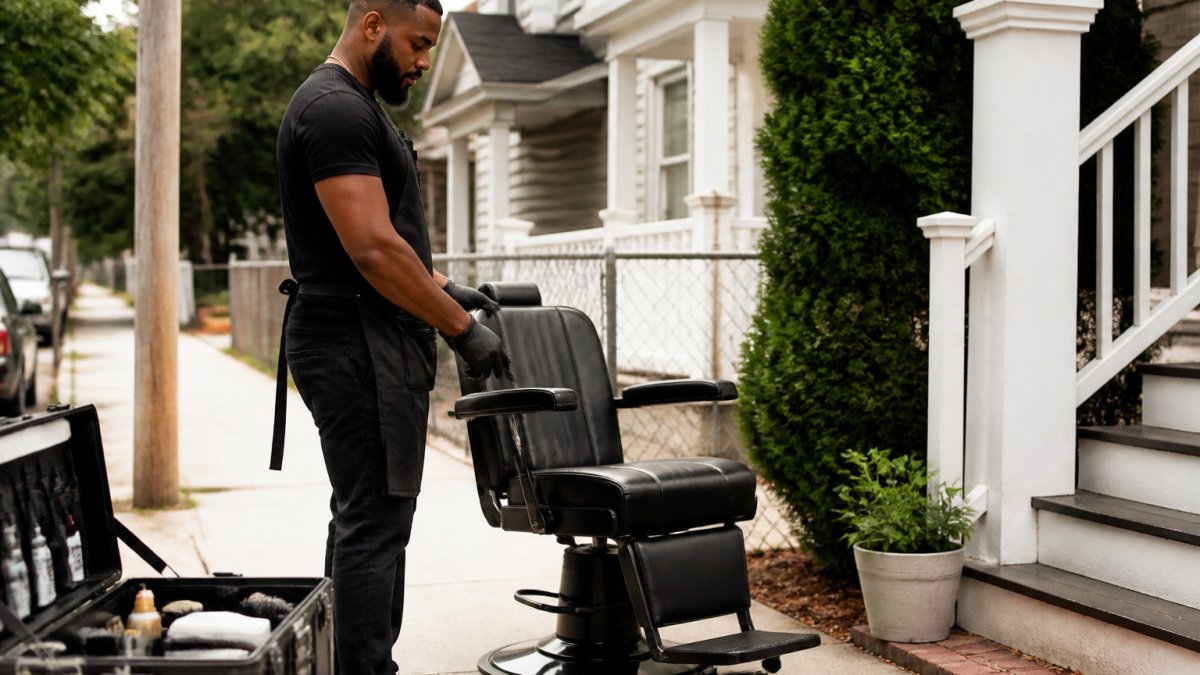
Client booking control matters as much as the calendar itself. Set a clear cancellation policy in the booking page, and use reminders to confirm each appointment.
Watch out: Do not rely on a single reminder. Send one confirmation when the booking is made and a second reminder the day before.
Choosing Your Barber Appointment Scheduling Software
Start with your five criteria, then shortlist two or three platforms. Use a free trial for each, book a few test appointments, and check how the mobile app behaves during a real working day. Look at the total annual cost, not only the monthly price. And confirm that you can export your client data before you commit, so you are never locked into a platform you no longer want.
If you are a solo mobile barber, prioritise phone access, reminders and simple payments. If you are building a team, weight staff scheduling and cost per seat more heavily. Either way, make the decision on evidence from your own bookings rather than on the strength of a comparison table alone.
Frequently Asked Questions
What is the best StyleSeat alternative for mobile barbers?
No single platform wins for every mobile barber. Evaluate each on the features that matter to you: whether it works well on a phone, how it handles client profiles and reminders, and what it charges per booking or per month. Test two or three with a free trial before committing.
Which booking apps are best for independent barbers?
Independent barbers usually need a simple phone-first app with a public booking page, automated reminders and an easy way to store client preferences. Compare setup time, payment processing fees and whether the app supports deposits or a cancellation policy. Software built for barbershops may carry features a solo operator does not need, so check that you are not paying for unused staff tools.
Can barbers use booking software for mobile appointments?
Yes, provided the software works on a smartphone and lets you record the address or service area for each booking. Check whether travel time can be blocked in your calendar and whether the app works with limited connectivity, since mobile barbers often move between locations with patchy signal. Confirm these details directly with the vendor before you rely on them.
Is Booksy or StyleSeat better for barbers?
The better choice depends on how you work. Compare the monthly cost, transaction fees, how client profiles and booking history are stored, and how easily you can switch to a different platform later. Export your client data during a trial to confirm you can move it if you change providers.