 How-to
7 Things to Look for in a Professional Braider
Quick Summary
A professional braider should have a strong portfolio showing work on hair similar to yours, clean tools and sanitation practices, and clear answers about training and licensing. Most importantly, they should manage braid tension well, since pulling too tight can damage your edges and scalp. Ask direct questions before booking to see how they work.
- Check the portfolio for unedited, close-up photos of work on your hair type.
- Ask whether tools are cleaned between clients and whether extension hair is opened fresh.
- Confirm which license or registration applies where you live and ask to verify it.
- Tension should feel secure, not painful; burning or bumps mean the braids are too tight.
- Ask for two recent client references who had the same style and hair type.
Table of Contents
- Why Choosing the Right Braider Matters for Your Hair and Scalp
- Step 1: Review the Braider's Portfolio for Your Style
- Step 2: Check Hygiene, Tools, and Sanitation Practices
- Step 3: Confirm Training, Experience, and Local Licensing
- Step 4: Assess Braid Tension and Sizing Standards
- Step 5: Ask the Right Questions Before You Book
- Step 6: Understand Timing, Pricing, and Appointment Policies
- Booking Your Next Braid Appointment Through Alyry
- Frequently Asked Questions
7 Things to Look for in a Professional Braider
Last Updated: October 29, 2026
Why Choosing the Right Braider Matters for Your Hair and Scalp
Choosing a braider is more than booking a time slot. Tight, poorly sectioned braids can pull on your edges, irritate your scalp, and leave you with hair that breaks within weeks. Knowing what to look for in professional braiders helps you avoid those outcomes.
This guide walks through seven things to check before you book. Each step gives you a clear question to ask or a signal to look for.
Step 1: Review the Braider's Portfolio for Your Style
Start with photos. A strong portfolio shows braids on hair textures and lengths similar to yours. A braider who does beautiful box braids on fine hair may struggle with coils or locs.
Look for:
- Clear, close-up photos that show part lines, edges, and braid uniformity
- Work on your hair type, whether that is 4C coils, relaxed hair, or extensions
- Consistency across multiple photos, not just one standout set
Watch out: a portfolio full of heavily edited or filtered photos can hide uneven parts. Ask to see a recent unedited photo instead.
Step 2: Check Hygiene, Tools, and Sanitation Practices
Clean tools and a clean station protect your scalp. Many braiders wipe down combs, clips, and work surfaces between clients. Others use fresh, sealed packs of hair and disposable supplies.
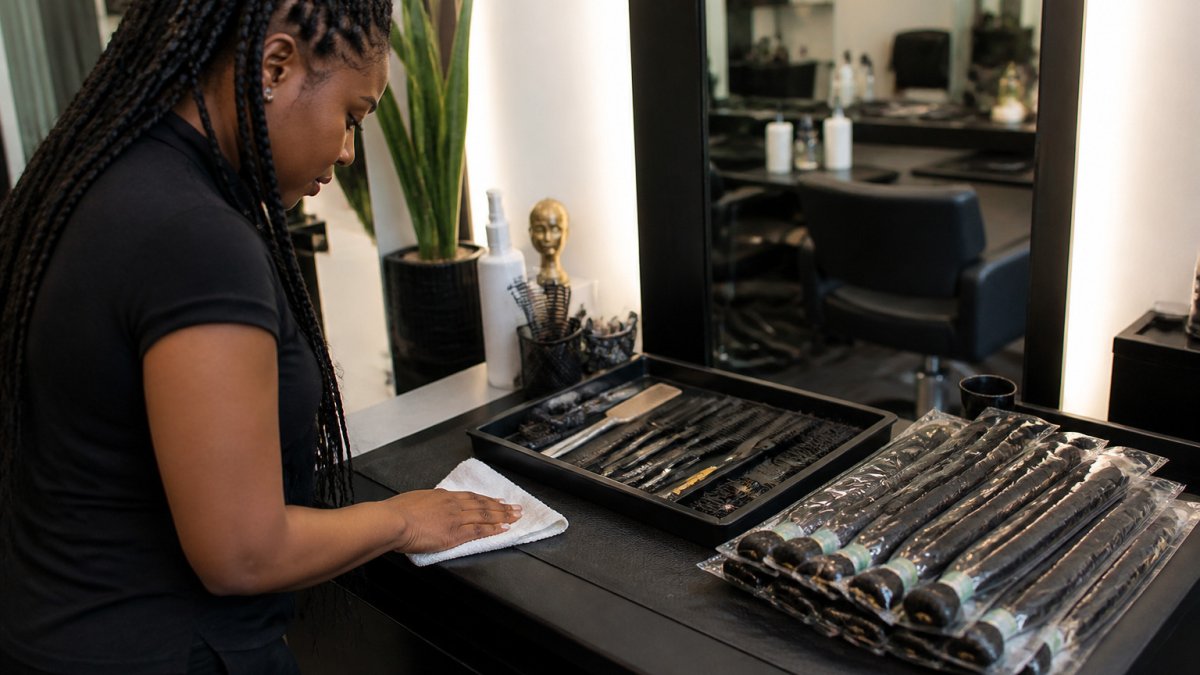
Before you book, ask:
- Are tools cleaned or disinfected between clients?
- Is extension hair opened fresh for each appointment?
- Does the braider wear gloves or wash their hands before starting?
A professional who answers these clearly is usually running a tidy, organized station.
Step 3: Confirm Training, Experience, and Local Licensing
Braiding regulation is genuinely inconsistent. In some places, natural hair braiding is explicitly exempt from cosmetology licensing; in others, braiders must hold a specific license, register with a state board, or complete a set number of training hours. Because the rules vary, the useful question is not "are you licensed?" but "what applies here, and can you show me?"
Licensing versus certification versus training
These three terms get used interchangeably, but they mean different things:
- Licensing is a legal requirement set by a state, province, or local authority. It usually involves a set number of training hours, an exam, and periodic renewal. Whether braiding falls under it depends on where you live.
- Certification is typically a private credential from a training program, brand, or association. It shows completed coursework but is not the same as a government license.
- Training and apprenticeship describe how someone learned the craft, formal school, a mentorship under an established braider, or self-taught experience. None of these are inherently better, but they tell you what kind of feedback the braider has received.
A braider can be highly skilled without a license, and a licensed braider can still be a poor fit for your hair type. Treat credentials as one input, not the whole decision.
How to check what applies where you live
- Search your local cosmetology or barbering board, most publish whether natural hair braiding requires a license and what the training hours are.
- Ask the braider directly which license or registration they hold, and with which authority.
- Verify the number against the board's public lookup if one exists. Many boards let you search by name or license number.
- Ask what their training covered, specifically whether it included scalp health, tension management, and working with extensions on your hair type.
If a braider cannot name the authority they are registered with, that is not automatically disqualifying, but it is worth asking a follow-up question about how they learned and how they keep their skills current.
Experience questions that reveal more than years
"How many years have you been braiding?" is a weak question because it does not tell you what kind of experience. Better questions:
- How many appointments of this specific style do you do in a typical month?
- What hair types and densities do you work with most often?
- Have you worked with my hair type at my current length before?
A braider who answers these with specifics, not vague reassurance, is showing you their working knowledge. Someone who deflects or gets defensive about basic questions is giving you information too.
What credentials do not tell you
A license or certificate does not guarantee good tension, clean tools, or a style you will love. It also does not guarantee the braider keeps up with current techniques. Use credentials to filter out obvious mismatches, then rely on the portfolio, hygiene questions, and tension standards in the sections above to make the final call. For a broader look at screening, read how to find vetted hair stylists.
Step 4: Assess Braid Tension and Sizing Standards
Tension is the single most important safety signal in braiding, and it is also the hardest to judge from photos. A braid can look flawless and still be too tight at the root. Knowing what to look for in professional braiders means knowing how a good braider manages tension before, during, and after the appointment.
What healthy tension feels like
A well-tensioned braid is secure but not painful. You should be able to:
- Turn your head, nod, and lie on a pillow without sharp pulling
- Slide a fingertip under the braid at the hairline without lifting the scalp
- Feel even pressure across the head rather than hot spots at the temples, nape, or edges
A common pattern among experienced braiders is to braid slightly looser at the hairline and nape, the areas most prone to traction, and firmer through the mid-shaft where the braid needs to hold. If every braid feels equally tight from root to tip, ask why.
Signs of excessive tension
Watch for these during and immediately after the appointment:
- Burning or stinging at the scalp, especially at the hairline
- Small bumps or pimples along the parts (folliculitis-type irritation)
- White or raised bumps where the braid meets the scalp
Traction alopecia, gradual hair loss from repeated pulling, is a well-documented risk of tight protective styles. It often starts at the edges and temples and can become permanent if the pulling continues. You do not need a diagnosis to act: if a style hurts, it is too tight.
Sizing consistency and sectioning
Tension and sizing are linked. Uneven sections force the braider to over-compress some braids to make them match others. Look for:
- Clean, straight part lines with no zigzagging or crossed sections
- Braid size that matches what you agreed on, if you asked for medium box braids, you should not leave with a mix of medium and jumbo
- Consistent braid count on both sides of the head
Ask the braider before the appointment how they map sections for your chosen style. A braider who can explain their parting pattern, for example, how many rows at the front, how they handle the crown, is usually working from a plan rather than improvising.
When to speak up, loosen, or remove
You do not have to wait until the appointment ends to raise a concern. Say something as soon as you feel sharp pulling. A skilled braider will redo the section or adjust tension without argument.
After the appointment, give the style 24 to 48 hours. Mild tightness that fades is common. Escalating pain, numbness, or visible skin irritation is not. If any of the following occur, loosen or remove the style rather than waiting it out:
- Pain that gets worse instead of better after two days
- Numbness or tingling around the scalp or temples
- Open sores, scabs, or weeping bumps along the parts
Removal is not a failure. A braider who supports your decision to take a style down when it hurts is demonstrating the professionalism you are trying to vet.
Tension is the most important safety signal in braiding, and the signs below help you tell healthy tension from excessive tension.
| Signal | What it means | What to do |
|---|---|---|
| Sharp pulling during braiding | Braids are too tight | Say so right away; ask for a redo |
| Burning or stinging at the hairline | Excessive tension at the edges | Loosen or remove the style |
| Small bumps along the parts | Irritation along the scalp | Take the style down |
| Headache that persists after braiding | Tension is too high | Loosen or remove the style |
| Hair coming out in clumps at the root | Traction damage | Remove the style |
| Pain that worsens after two days | Escalating irritation | Loosen or remove the style |
Step 5: Ask the Right Questions Before You Book
A short conversation before booking can reveal a lot. Good braiders are happy to explain their process.
Questions worth asking:
- How long will this style take, and how many hours should I plan for?
- Should my hair be washed, stretched, or trimmed before the appointment?
- What products do you use to finish the braids?
Step 6: Understand Timing, Pricing, and Appointment Policies
Pricing depends on the style, length, hair quantity, and the braider's experience. Ask for a clear quote before the appointment starts, and confirm what is included, such as hair, product, or a takedown.
Also check:
- Deposit requirements and whether they are refundable
- Late arrival policy, since long styles may need extra time
- Payment methods accepted at the appointment
For current pricing and booking details, check the individual professional's profile or contact them directly.
Booking Your Next Braid Appointment Through Alyry
Now that you know what to check, you can compare braiders with confidence. Alyry is a verified marketplace for barbers, braiders, stylists, nail technicians, and makeup artists, where you can book appointments with the right specialist for your style. Start with the portfolio and booking questions above before you commit.
Frequently Asked Questions
How do I know if a braider is experienced and professional?
Look for a consistent portfolio of finished work in the style you want, clean and even parting, and braids that hold their shape. Ask how many years they have braided that specific style and whether they can show recent work. A professional should be able to explain their process for sectioning, tension, and sanitation without hesitation, and should be willing to answer questions before you commit to an appointment.
How tight should braids be?
Braids should feel snug but never painful. If you feel sharp pain, burning, or a tight pulling sensation at the scalp, the tension is too high and can lead to traction stress over time. Tension should feel secure enough that the braid holds for weeks, but your scalp should stay comfortable throughout the appointment. Speak up during the service if something feels wrong, since a skilled braider will adjust immediately.
What should I ask a braider before booking?
Ask how they prepare your hair and whether it should be washed or detangled beforehand, what products they use, how they sanitize tools between clients, and how long the style typically takes. Also ask about their pricing structure, whether it includes hair or extensions, and their cancellation policy. Clear answers to these questions are a good sign of a braider who runs a reliable, transparent business.
How long do box braids take?
Box braids usually take several hours, and the time depends on hair length, braid size, and how many packs of extensions are used. Smaller braids take longer than larger ones because there are more sections to create. Ask the braider for an estimated time when you book, and plan for the appointment to run long on the first visit, especially for a full head of small braids.