 How-to
7 Ways to Compare Beauty Professional Portfolios
Last Updated: November 21, 2026
Quick Summary
To compare beauty professional portfolios, score each one on technical skill, consistency, range, and presentation using a weighted rubric, then verify authenticity with reverse image searches and process shots. Judge like work against like work and confirm photos with recent, specific reviews before booking.
- Technical skill carries 35 points, the heaviest weight in the scoring rubric.
- Consistency is scored on quality holding across 10 or more photos.
- Reverse image search your strongest photos to confirm the work is theirs.
- Compare bridal work against bridal work and editorial against editorial.
- Reviews that describe a specific result tell you more than generic praise.
Table of Contents
- Start With a Side-by-Side Portfolio Comparison Framework
- Score Technical Skill, Consistency, Range, and Presentation
- Check Authenticity: How to Verify Portfolio Work Is Real
- How to Compare Beauty Professional Portfolios Online
- Bridal Makeup Portfolio: What to Look For Before a Wedding
- Makeup Portfolio Examples That Show Range and Signature Style
- Use Beauty Professional Reviews to Confirm What Photos Show
- Book a Vetted Professional on Alyry With Confidence
- Frequently Asked Questions
Start With a Side-by-Side Portfolio Comparison Framework
Comparing beauty professional portfolios is the practice of judging a stylist's or makeup artist's work against fixed criteria rather than against how impressed you feel in the moment. A pretty gallery tells you little until you know what to look for. Below, you will find a method for comparing portfolios side by side, scoring them, and spotting ones that are not what they claim to be.
Most people scroll a portfolio the way they scroll social media. They stop at the images that pop. That is the wrong instinct, and it is why so many clients book someone whose feed looks stunning and whose work on the day falls flat.
A portfolio is evidence, not decoration. Treat it like a quote from a tradesperson: you are checking what is included, what is missing, and whether the details hold up.
The Four Dimensions That Actually Matter
Every portfolio you review should be judged on four things, in this order:
- Technical skill - clean lines, even color, neat edges, balanced shapes.
- Consistency - does the quality hold across ten photos, or only the best one?
- Range - can they handle your hair type, skin tone, or occasion?
- Presentation - are the photos honest, clear, and recent?
A professional who scores well on all four is a safe booking. One who scores high on presentation but low on consistency is a risk.
Score Technical Skill, Consistency, Range, and Presentation
A weighted scoring rubric turns a vague "I like their work" into a number you can compare. A scoring approach like this one can help you compare portfolios.
| Dimension | Weight | What to Score | Red Flag |
|---|---|---|---|
| Technical skill | 35 points | Clean edges, even tone, neat finish | Blurry roots, patchy color, harsh lines |
| Consistency | 25 points | Same quality across 10+ photos | One great shot, weak rest |
| Range | 25 points | Different styles, hair types, occasions | Only one look repeated |
| Presentation | 15 points | Clear, recent, unedited photos | Heavy filters, cropped shots |
Weight
Score each portfolio honestly, and treat low scores as a reason to look more closely before booking.
Technical skill carries the most weight because it is the hardest to fake and the most obvious on the day. Consistency matters next: a professional who posts ten strong images is far more reliable than one with a single viral shot. Range tells you whether they can handle your specific request. Presentation is last because filters can hide flaws, so a heavily edited gallery should lower your trust, not raise it.
Check Authenticity: How to Verify Portfolio Work Is Real
The most common mistake clients make is assuming every photo in a gallery belongs to the artist who posted it. Some do not. Stock images, other people's work, and heavily filtered shots all appear on booking platforms.
Here is how to check:
- Reverse image search a few of the strongest photos. If they appear on unrelated sites, the work is not theirs.
- Look for process shots. Real artists usually post a mid-process photo or a behind-the-scenes clip alongside the finished look.
- Check the background. Consistent studios, tools, and settings across photos suggest genuine work.
- Ask directly. A confident professional will happily explain a specific look and how they achieved it.
If you want a deeper walkthrough on confirming credentials, our guide on how to verify beauty professional credentials covers the checks step by step.
How to Compare Beauty Professional Portfolios Online
Comparing beauty professional portfolios online is harder than comparing them in person because you cannot see the work under your own lighting or ask questions in real time. The screen flattens everything: a ring-lit studio shot and a phone photo in daylight can make the same technique look completely different.
Start by opening both portfolios in separate browser tabs or windows so you can flip between them without losing your place. Then follow these steps in order.
- Compare like with like. Judge bridal work against bridal work, editorial against editorial, and natural-light shots against natural-light shots. Mixing categories is the fastest way to reach a wrong conclusion.
- Check the lighting in each gallery. Look for at least one natural-light or unedited photo per portfolio. If every image is shot under a ring light or heavy filter, you are comparing lighting setups, not skill.
- Note the dates. Recent work reflects current skill. A gallery dominated by photos from five years ago tells you what the artist could do then, not now.
- Read the captions. Artists who name the technique, product, or occasion are usually more transparent and easier to verify. Captions also tell you whether the poster is the artist or a repost account.
- Check the image file itself. On many platforms you can right-click or long-press a photo and view its details. A file name like
IMG_2043is normal; a file named after a stock agency or another artist is a red flag. - Cross-check across platforms. Search the artist's name plus the service on a second platform. Consistent portfolios across two or three sites are a stronger signal than a single polished gallery.
Platform choice changes what you can verify. Some booking platforms attach client reviews to specific looks, which can give you a second layer of evidence. Social platforms show volume and recency but rarely tie a photo to a completed booking.
Watch out: a portfolio that looks identical across three platforms but has no reviews, no process shots, and no captions is often a curated collection rather than a working artist's record. Absence of evidence is not proof of fraud, but it should lower your confidence and push you toward asking direct questions before you book.
For a deeper walkthrough on confirming credentials and spotting reposted work, our guide on how to verify beauty professional credentials covers the checks step by step.
Bridal Makeup Portfolio: What to Look For Before a Wedding
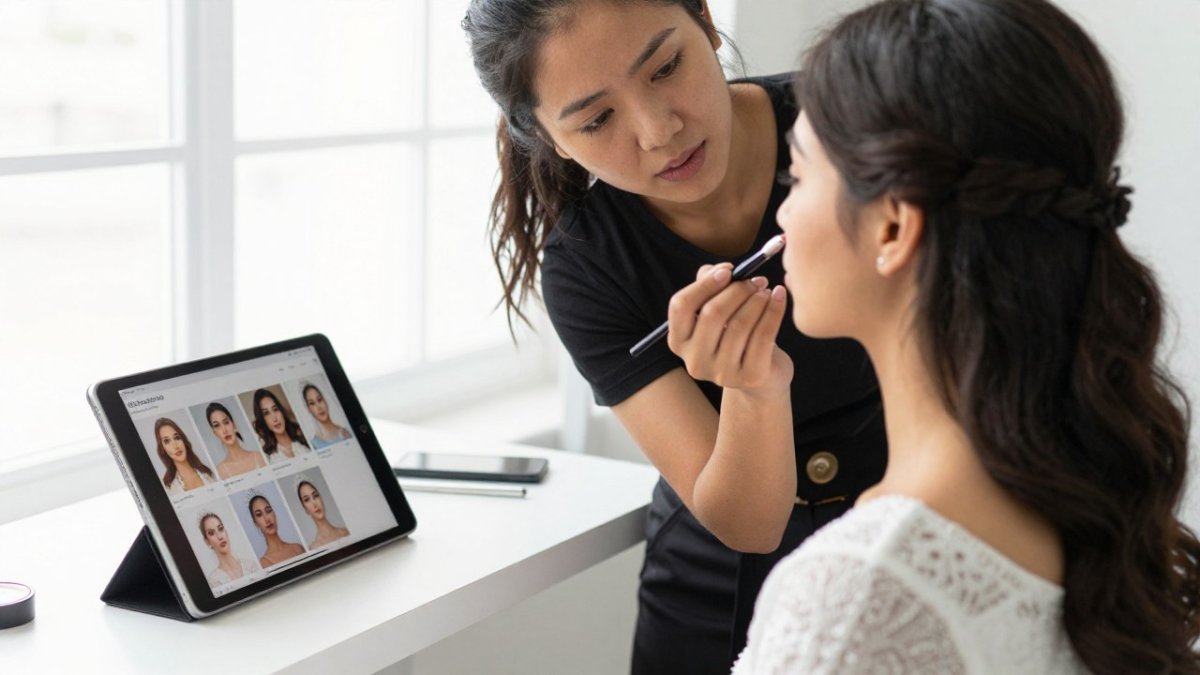
A bridal makeup portfolio needs different checks from a general one.
Look for these specifics:
- Full-face, well-lit photos rather than tight crops that hide blending at the jawline, hairline, and neck. A crop is sometimes artistic, but a portfolio made entirely of crops hides the parts of the face that reveal technique.
- Different skin tones and undertones. Bridal work requires foundation matching across a wide range, so a gallery that only shows one skin tone is a range warning, not a style choice.
- Long-wear evidence. Look for texture and sheen that suggest a finish designed to hold through ceremony and reception. Matte, satin, and dewy finishes all photograph differently, and the portfolio should show the artist can control each one.
- A mix of ceremony and reception looks. The same face has to hold up all day, and artists who show both stages are usually more transparent about touch-up expectations.
- Trial-to-wedding consistency. If the artist posts trial looks alongside wedding-day photos, compare them. A close match shows reliable execution; a large gap suggests the trial was a one-off best effort.
- Process and hygiene signals. Portfolio visuals rarely show sanitation, but many bridal artists post behind-the-scenes clips that reveal brush cleaning, disposable applicators, and a organized kit. These are legitimate portfolio evidence, not just marketing.
A common pattern among experienced bridal artists is to organize wedding work by venue type or season, because outdoor summer weddings and winter evening ceremonies demand different products and techniques.
Before you commit to a wedding artist, it also helps to understand what the work typically involves cost-wise. Our breakdown of wedding makeup artist cost explains what brides actually pay and what drives the price up or down.
Makeup Portfolio Examples That Show Range and Signature Style
Strong makeup portfolio examples share one trait: you can tell they belong to the same artist without every look being identical. That is the difference between range and repetition.
A portfolio with real range will show:
- Natural and clean beauty looks for everyday clients.
- Glam and evening makeup for events.
- Editorial or creative work that shows technical ambition.
- Bridal and occasion looks with a polished finish.
- Corrective and contour work on different face shapes.
A signature style sits on top of that range. It might be a particular approach to skin, a preference for soft blending, or a consistent color palette. When you compare portfolios, ask yourself whether the artist's style suits what you want. A brilliant editorial artist may not be the right choice for a natural bridal look, and that is not a flaw, it is a fit issue.
Use Beauty Professional Reviews to Confirm What Photos Show
Reviews are the second half of the comparison. Photos show what an artist can do; reviews tell you what the experience was actually like.
Read reviews with three questions in mind:
- Does the reviewer describe a specific result? "Loved it" tells you little. "My color held for eight weeks" tells you a lot.
- Do multiple reviews mention the same strength or problem? Patterns matter more than single comments.
- Are the reviews recent and varied? A wall of identical five-star reviews is a warning sign, not a comfort.
Our article on red flags in salon reviews breaks down the specific patterns that signal fake or misleading feedback, which is worth reading before you trust any gallery at face value.
Book a Vetted Professional on Alyry With Confidence
The final step is turning your comparison into a booking. That is where a verified marketplace saves you time. Alyry is a verified marketplace that connects you with barbers, braiders, stylists, nail technicians, and makeup artists.
Instead of cross-referencing several sites, you can compare portfolios inside one platform. If you want to understand why that matters, our guide on why use a verified booking platform explains the protection it offers. When you are ready to act, you can book verified local makeup artists online and compare their work side by side before you commit.
Comparing beauty professional portfolios is not about finding the prettiest gallery. It is about finding the artist whose evidence holds up under scrutiny: consistent work, real photos, honest reviews, and a style that fits your occasion.
Frequently Asked Questions
What should a beauty professional's portfolio include?
A strong portfolio shows recent work samples across the services the professional offers, not just one look. Look for high-quality images of finished results, before-and-after photos where relevant, and a clear signature style. It should also indicate the professional's specialty, such as bridal makeup, color work, or natural makeup. Portfolios that organize work into sections by service make it easier to judge range and consistency at a glance.
How can you tell if beauty portfolio photos are authentic?
Check whether the same face, lighting setup, or editing style appears across multiple images, and look for consistent photo quality rather than a few polished shots mixed with blurry ones. Cross-reference the portfolio with beauty professional reviews and tagged client photos on social media. Ask the professional directly which images are their own work and whether any were taken in a group or assisted setting.
Should you choose a beauty professional based on portfolio photos alone?
No. Photos show technical skill and presentation, but they do not confirm hygiene practices, punctuality, or how a professional communicates. Use the portfolio as a first filter, then check beauty professional reviews and ask about process, sanitation, and consultation before booking. A short conversation often reveals more about reliability than a gallery of edited images.
How many examples should a professional portfolio show?
A portfolio with 10 to 20 recent work samples usually gives enough evidence to judge consistency and range without overwhelming the viewer. Fewer than six images makes it hard to see a pattern, while dozens of older photos can hide inconsistency. Prioritize recent work over volume, and check whether the samples match the specific service you are booking.