 How-to
7 Red Flags in Salon Reviews You Should Never Ignore
Last Updated: October 25, 2026
Quick Summary
Fake salon reviews often display overly positive language, generic wording without specific service details, and clustered posting patterns rather than gradual growth. You can spot fake salon reviews by checking for perfect 5.0 ratings, thin reviewer profiles with no history across other businesses, and identical phrasing repeated across multiple reviews.
- Real salon reviews mention specific details like stylist names, techniques, duration, and aftercare instructions that fake reviews lack
- Suspicious review patterns include five or more posted in one day, then nothing for weeks, while genuine reviews arrive gradually over time
- Check reviewer profiles by clicking names; real reviewers have history across different businesses over months or years, while fake profiles show only one or two reviews for the same salon
- Compare ratings across platforms like Google, Yelp, Instagram, and Facebook; real salons maintain similar ratings while inflated platforms stand out
- A salon rating between 4.0 and 4.8 stars with at least 20 reviews is more credible than a perfect 5.0, which is statistically rare in personal services
Table of Contents
- Why Fake Salon Reviews Matter When You're Booking
- Signs of Fake Online Reviews: What to Look For
- How to Tell If Google Reviews Are Fake
- How to Verify Salon Reviews Across Platforms
- Booking Apps with Verified Professional Reviews
- Your Verification Checklist Before Booking
- What to Do If You Suspect a Fake Salon Review
- Book with Confidence on a Verified Marketplace
- Frequently Asked Questions
Why Fake Salon Reviews Matter When You're Booking
Fake salon reviews cost you time, money, and confidence. A stylist with inflated ratings might disappoint you before a big event; a colorist with fabricated five-star reviews could damage your hair.
The good news: spotting fake salon reviews follows patterns. Once you know what to look for, you'll move through reviews faster and book with confidence. Why Use a Verified Booking Platform explains the bigger picture; this guide covers the specific red flags.
Signs of Fake Online Reviews: What to Look For
Salon reviews differ from restaurant or product reviews because the reviewer describes a personal service performed on their own hair, skin, or nails, giving you salon-specific clues most generic guides miss. Use the patterns below together: no single sign proves a review is fake, but clusters are telling.
Overly Positive Language and Perfect Ratings
Real salon customers almost always mention a trade-off: "The balayage was exactly what I wanted, though the appointment ran 20 minutes long." That nuance is hard to fake at scale.
Fake reviews read like advertisements, with phrases like "absolutely perfect" or "life-changing experience" repeated across reviews for the same salon. A salon with 50+ reviews and a 4.9 rating is more credible than one with a 5.0, perfect scores are statistically rare in personal-service businesses.
Generic Wording and Lack of Specific Details
Real salon customers describe services specifically: "She did a root smudge and blended my grown-out highlights," or "The keratin treatment took two hours and she warned me not to wash it for 72 hours."
Generic reviews use vague language, "Great service," "Best salon ever", without mentioning the stylist, technique, products, or appointment experience. That vagueness is a red flag.
Legitimate reviews include details only a visitor would know: the salon's layout, the consultation, how the stylist checked the length with you. Fabricated reviews skip these because the reviewer never sat in the chair.
Unusual Review Bursts and Timing Patterns
Real reviews arrive gradually, two or three a week. Fake reviews appear in clusters: five in a single day, then nothing for two weeks, then another burst.
Timing reveals manipulation: 20 new reviews after a public dispute with a customer, or a spike right after a competitor opens nearby, is suspicious.
If most reviews come from the same narrow window, all posted on weekends, all between 9 AM and 10 AM, that suggests automation.
Salon-Specific Clues: Service Details and Appointment Context
To judge whether a salon review is plausible, ask whether the reviewer describes a service the salon actually offers, delivered the way it actually works.
- Service menu match. Does the review mention a treatment the salon lists, a balayage, a silk press, a gel manicure, a beard trim, or a vague "hair service" that could apply anywhere?
- Time and process. Real clients often reference duration, consultation, or aftercare instructions ("she told me to wait 48 hours before washing"). Fake reviews rarely include process details because the writer never experienced them.
- Stylist specificity. A genuine review usually names the stylist or describes them ("the tall stylist with the pink chair"). If every review praises "the team" without a single name, treat that as a soft signal, not proof.
No clue is decisive alone. Weigh them together: a review that is vague, perfectly glowing, and mismatched to how the service works is far likelier to be fabricated than one with a small, believable imperfection.
Watch for these common patterns that reveal fabricated salon reviews.
| Red Flag | What It Looks Like | Why It Matters |
|---|---|---|
| Perfect ratings | 5.0 stars consistently | Perfect scores are statistically rare in personal services |
| Overly positive language | Phrases like "absolutely perfect" or "life-changing" | Real reviews mention trade-offs and minor issues |
| Generic wording | "Great service" with no specific details | Fake reviewers never sat in the chair |
| Missing service details | No mention of stylist, technique, or duration | Real clients describe specific appointments |
| Review clusters | Five reviews in one day, then nothing for weeks | Natural growth is steady; artificial growth is obvious |
| Thin reviewer profiles | One or two reviews, all for same salon | Suggests coordination rather than organic feedback |
| Repeated phrases | Identical wording across multiple reviews | Real customers use different language and tone |
How to Tell If Google Reviews Are Fake
Google is the most common platform for salon reviews and where fakes cluster most visibly. Its systems catch some, but the signals that matter most are the ones you can check yourself in minutes.
Checking Reviewer Profiles and Review History
Click the reviewer's name. A real profile shows reviews across different businesses and categories, restaurants, shops, salons, gyms, spread over months or years, in a consistent voice.
Fake profiles are thin: one or two reviews, all for the same salon or area, or a new account that immediately posts multiple five-star ratings for one business. That suggests coordination, not organic feedback.
Real reviewers often include photos, a finished haircut, a set of nails. Fake reviews rarely do, because the reviewer never visited. A profile silent everywhere except one salon is worth a second look.
Identifying Coordinated or Repeated Wording
Read several reviews side by side. Fake reviews repeat the same phrases, "absolutely loved it" in three, "highly recommend" identically across four. Real customers use different language.
If five reviews follow the same pattern, "The stylist was amazing. The salon is beautiful. I will definitely return", that's coordination. Real reviews vary in length, tone, and focus.
Fake reviews sometimes reuse the same emoji combinations or praise the same details in identical phrasing ("the friendly receptionist").
Practical method: copy three or four reviews into a notes app and read them in sequence. Coordinated reviews share a rhythm, same opening, compliment order, closing line, that's hard to see one at a time.
Weighing Reviews Across Platforms and Over Time
No single platform tells the whole story. A salon might have bought Google reviews while keeping honest feedback on Instagram. Cross-platform comparison reveals the truth.
Check the salon's ratings on Google, Yelp, Instagram, TikTok, and Facebook. Real salons tend to maintain similar ratings across platforms.
Google reviews tend to be longer; Instagram comments shorter; Yelp reviews often include photos. Real salons show naturally different styles across platforms, identical text copied across them stands out.
Weigh reviews over time: 200 reviews over three years is more trustworthy than 200 in three months. If a salon had mixed reviews two years ago but only five-star reviews now, ask what changed. Volume alone doesn't prove legitimacy: 50 genuine reviews beat 500 where half are fake.
Reporting Suspicious Reviews and Understanding Platform Limits
If a review looks fake, report it. On Google, open the review, tap the three-dot menu, choose the report option, select the reason (spam or fake engagement), and add a short factual note, repeated wording, a profile with no history, or a service the salon doesn't offer.
Removal isn't guaranteed: automated tools produce false positives and negatives, so treat a score as a clue, not a verdict. Avoid uploading screenshots that expose other reviewers' personal information.
How to Verify Salon Reviews Across Platforms
No single platform tells the whole story. Salons sometimes buy reviews on Google while maintaining honest feedback on Instagram. Others might have great reviews on Yelp but fake ones on Google. Cross-platform comparison reveals the truth.
Cross-Platform Comparison and Rating Consistency
Check whether the salon responds to reviews. Real salons thank customers and address complaints; salons with fake reviews often ignore negative feedback or respond defensively.
Read the negative reviews. Real salons have real complaints: wait times, pricing, stylist preferences. Fake salons have none at all, or obviously fake ones ("Worst experience ever, no details").
Weighing Reviews Over Time and Volume
Consider the reviewer-to-appointment ratio: a salon booking 100 appointments a month but getting one or two reviews is normal; 50 reviews in a month is unusual.
Booking Apps with Verified Professional Reviews
The easiest way to avoid fake reviews is a platform that verifies them. Booking Apps With Verified Professional Reviews covers how platforms differ; the key principle: verified reviews come from customers who actually booked and paid through the platform.
Verified platforms like Alyry cross-reference reviews with actual appointments: a customer can only review after completing a booking.
Verification doesn't mean every review is perfect. Real customers still post mixed feedback. But verification means every reviewer actually visited the salon. That changes everything.
Your Verification Checklist Before Booking
Before you book, run through these checks. They take five minutes and eliminate most risk.
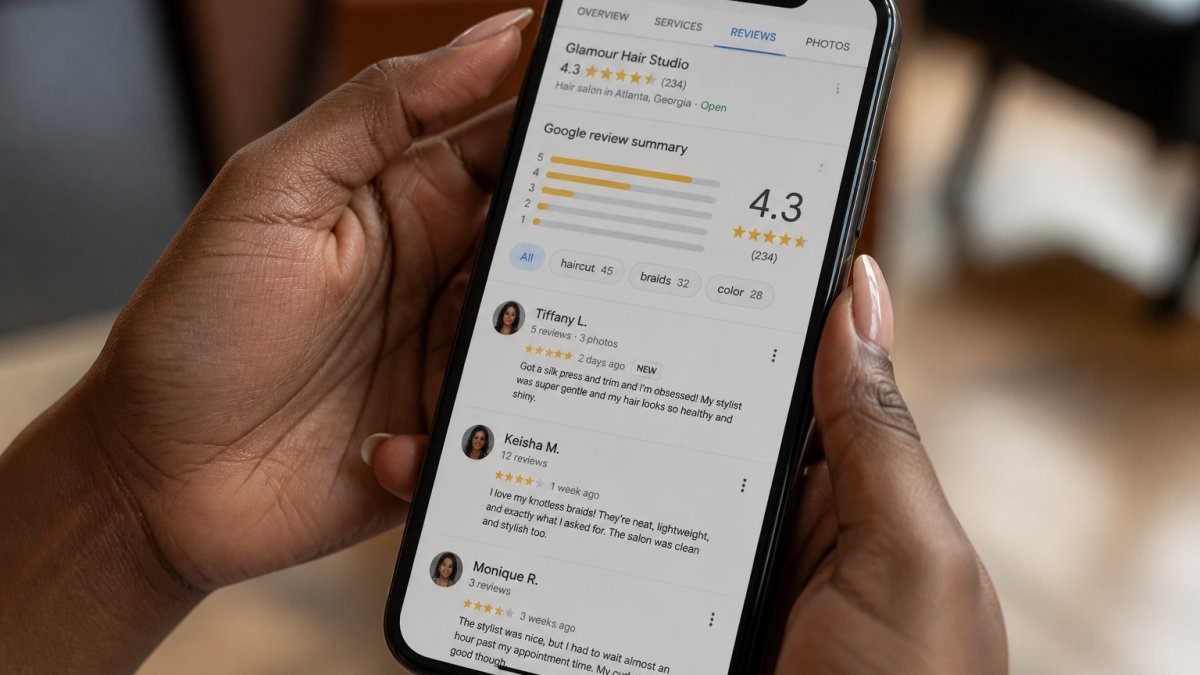
Step 1: Check the overall rating and review count
- Is the rating between 4.0 and 4.8 stars? (Perfect 5.0 is suspicious)
- Are there at least 20 reviews? (Fewer than 20 is too small a sample)
- Did reviews arrive gradually over time or in clusters?
Step 2: Read recent reviews in detail
- Do they mention specific services, stylist names, or techniques?
- Do they acknowledge any minor issues or trade-offs?
- Do they sound like real people or advertisements?
Step 3: Examine reviewer profiles
- Click three random reviewers
- Do they have review history across different businesses?
- Do they have photos in their other reviews?
Step 4: Look for repeated language
- Read five different reviews
- Do they use identical phrases or similar sentence structure?
- Do they mention the same details in the same way?
Step 5: Compare across platforms
- Search the salon on Google, Yelp, and Instagram
- Are the ratings similar across platforms?
- Do the reviews sound consistent in tone?
Step 6: Check the salon's response pattern
- Does the owner respond to reviews?
- Are responses thoughtful or generic?
- Do they ignore negative feedback?
How to Verify Beauty Professional Credentials (2026 Guide) goes deeper into verification methods, but this checklist covers the most important signals.
What to Do If You Suspect a Fake Salon Review
If you spot fake reviews, you have options: report them, avoid the salon, or contact the salon directly.
Report the review to the platform. On Google or Yelp, click the three dots on a suspicious review, select "Report," and describe why you think it's fake. Platforms remove reviews that violate their policies.
Don't book from that salon. If something feels off about the reviews, move on, the risk isn't worth it.
Leave your own honest review. Genuine feedback pushes out fake reviews over time, the more real reviews a salon accumulates, the less impact fake ones have.
Book with Confidence on a Verified Marketplace
Fake reviews exist because traditional booking creates uncertainty. You can't know a stylist until you visit. Reviews are supposed to bridge that gap.
Alyry solves this by verifying professionals directly. Reviews come only from customers who booked through us, so you're choosing from vetted professionals, not anonymous feedback.
When you book on Alyry, you get verified professionals. Get started with Alyry and book your next appointment with confidence.
Frequently Asked Questions
What are the most obvious signs of a fake salon review?
Fake salon reviews often share common patterns: all five-star ratings with no variation, generic praise without specific service details, identical wording across multiple reviews, and reviewer profiles with no history or only recent activity. Look for reviews that mention the salon name repeatedly or use promotional language. Real customers typically mention specific stylists, services, pricing concerns, or appointment experiences. If a review reads like marketing copy rather than personal experience, it's likely fabricated.
How can I tell if Google reviews are fake for a salon?
Check the reviewer's profile: click their name to see their review history, location, and how long they've been active. Fake reviewers often have few or no other reviews, vague location data, or profiles created recently. Examine the timing of reviews: sudden clusters of five-star ratings within days suggest coordinated activity. Read carefully for first-hand details about the salon visit, stylist interaction, or specific service outcome. Genuine reviews mention real friction points (wait times, pricing, product recommendations) alongside positives. Cross-reference the salon's rating on Google with its ratings on other platforms; significant discrepancies raise red flags.
How do I verify salon reviews before I book an appointment?
Start by comparing the salon's ratings across multiple platforms: Google, Yelp, Instagram, and your booking app. Consistency suggests authenticity; wildly different ratings indicate potential manipulation. Read at least 10-15 reviews, not just the top ones. Look for reviews mentioning specific stylists, services, and outcomes. Check when reviews were posted: steady, sporadic posting over months is more credible than clusters. Visit reviewer profiles to confirm they have other reviews and a genuine history. Pay attention to negative reviews too: salons with only five-star ratings are suspicious. Finally, prioritize booking apps with verified professional reviews, where stylists are vetted and clients must book real appointments to leave feedback.
Should I trust a salon with only five-star reviews?
No. A salon with exclusively five-star reviews is a red flag, not a sign of excellence. Real businesses, no matter how excellent, receive occasional three or four-star ratings due to differences in client preferences, scheduling issues, or minor service variations. A healthy review profile typically includes mostly positive ratings (four to five stars) mixed with occasional lower ratings that feel authentic and specific. If a salon has hundreds of reviews all at five stars, especially if they clustered recently, investigate further by checking reviewer profiles and comparing ratings across platforms. Authentic salons show rating diversity and acknowledge constructive feedback.
Booking a salon appointment shouldn't require detective work. Real reviews from verified customers make the process simple. Use the checklist above, trust the patterns you spot, and book with platforms that verify their professionals. Your next great haircut is waiting.