 How-to
How to Get More Salon Bookings: A Step-by-Step Plan
Last Updated: November 8, 2026
Quick Summary
To get more salon bookings, first audit your booking funnel to find the stage where clients drop off, then fix that stage first. Make online booking quick and easy, keep your local listings accurate, collect reviews, and rebook clients before they leave. Track your booking conversion rate each week to confirm which changes work.
- Count clients at five funnel stages, from listing views to attended appointments, over at least four weeks.
- Put the booking button on your homepage and every service page, with a form of four fields.
- Keep your name, address, phone and hours identical across every map and directory listing.
- Book the next appointment at checkout and send reminders 24 hours and 2 hours before each visit.
- Start with free, high-impact fixes before spending money on paid ads or discount campaigns.
Table of Contents
- Step 1: Audit Your Current Booking Funnel
- Step 2: Make Online Booking Easy to Find and Use
- Step 3: Improve Local Search and Your Business Listings
- Step 4: Build Salon Social Media Marketing That Drives Bookings
- Step 5: Use Reviews, Referrals and First-Visit Offers
- Step 6: Rebook Clients Before They Leave and Cut No-Shows
- Step 7: Build a Budget-Based Plan and Track Results
- Booking Your Next Step with Alyry
- Frequently Asked Questions
Step 1: Audit Your Current Booking Funnel
Getting more salon bookings starts with knowing where clients drop off. Most salon owners guess at the problem. A short audit replaces guessing with facts.
Treat the booking path as a funnel with five measurable stages, and count how many people reach each one over the same period (a week is enough to start, four weeks gives a stable baseline):
- Profile or listing views, how many people see your salon on maps, directories, or social profiles.
- Website or booking-page visits, how many of those viewers click through to your site or booking page.
- Booking-page engagement, how many start selecting a service, date, or stylist.
- Completed bookings, how many confirm an appointment.
- Attended appointments, how many actually show up.
Each stage has its own conversion rate: views to visits, visits to engagement, engagement to booking, and booking to attendance. Calculate each one separately. A single weak stage tells you exactly where to spend your effort, which is more useful than a single overall number.
Walk through your own booking path as a new client would. Search your salon name, open your listing, tap the book button, and count every step until a time is confirmed. Note each point where you hesitate or need to look something up. Compare that experience against the stage counts: if many people view your listing but few visit the booking page, the problem is your listing or link. If many visit but few complete a booking, the problem is the booking flow itself.
Watch out: if the booking link leads to a dead page or a phone-only process, most new visitors leave before they book, and no amount of marketing will fix a broken final step.
Measuring Booking Conversion Rate
Your overall booking conversion rate is completed bookings divided by booking-page views. Track it weekly for at least four weeks before you change anything, so you have a baseline to compare against.
- Count booking page views from your website and listing profiles
- Count completed bookings from the same period
- Divide completed bookings by page views and multiply by 100
A common pattern is that the biggest drop-off sits at one stage, not evenly across all of them. Fix that stage first, then re-measure. Keep a simple log of the date, the change you made, and the stage counts before and after, so you can tell whether a tactic actually moved bookings or just felt busy.
The article lists five funnel stages and the conversion rates you should calculate between them.
| Funnel stage | What it measures | Conversion rate to calculate |
|---|---|---|
| Profile or listing views | People who see your salon on maps, directories or social | Views to website visits |
| Website or booking-page visits | Viewers who click through to your site or booking page | Visits to booking engagement |
| Booking-page engagement | Visitors who start choosing a service, date or stylist | Engagement to completed bookings |
| Completed bookings | Clients who confirm an appointment | Bookings to attended appointments |
| Attended appointments | Clients who actually show up | Final stage of the funnel |
Step 2: Make Online Booking Easy to Find and Use
Clients who cannot book in under a minute often book somewhere else. A clear booking button, a short form and visible open times do most of the work. This is one of the fastest ways to lift salon bookings online.
Put the booking button at the top of your homepage and on every service page. Keep the form to name, phone, service and preferred time. Show open slots early so clients do not have to fill in details only to find nothing free.
For a closer look at what a smooth booking experience involves, see Simple Ways to Book Beauty Appointments: A Practical Guide.
Step 3: Improve Local Search and Your Business Listings
Many clients search for a salon near them before they search for a specific stylist. Complete, accurate listings help you appear in those searches. Inconsistent names, old hours or missing photos cost you bookings.
Claim your business profiles on the major map and search platforms. Make sure your name, address, phone number and opening hours match across every listing. Add recent photos of your work and respond to every review.
Local search rules and map listing features change over time, so check the current guidance directly with the platform you use.
Step 4: Build Salon Social Media Marketing That Drives Bookings
Social media works for salons because clients want to see the results before they book. Before and after photos, short clips of a process and stylist introductions give people a reason to trust you. Each post should lead to a clear next step.
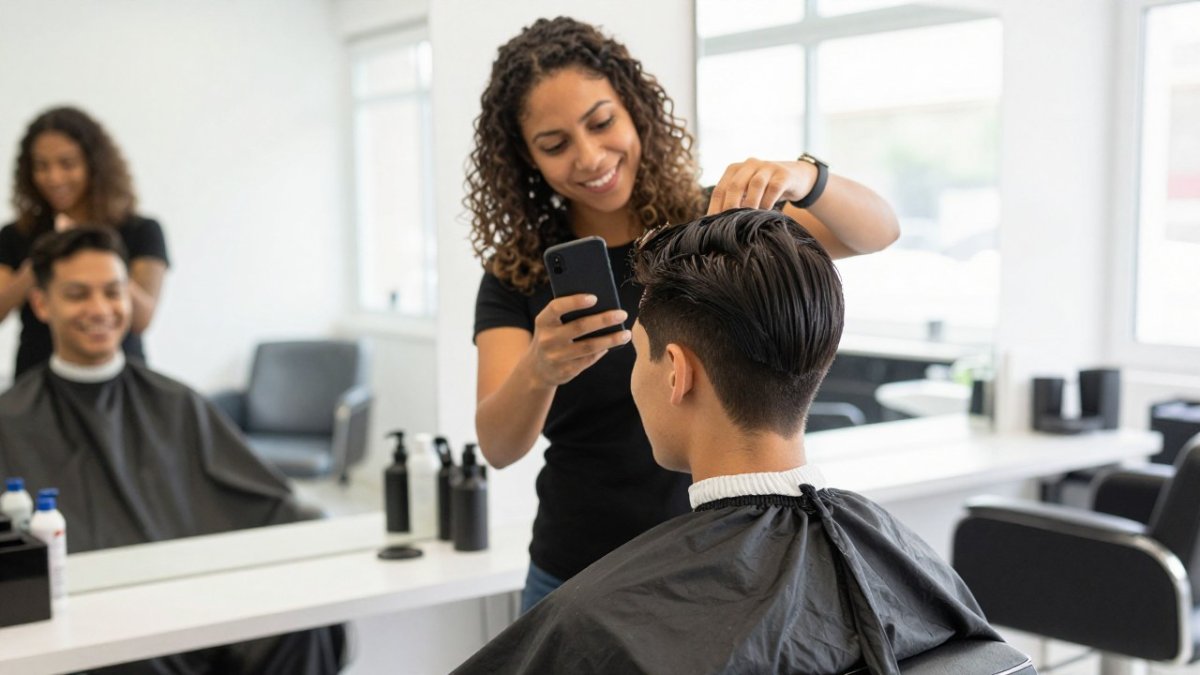
A stylist photographing a finished haircut on a smartphone in a bright salon station, with a client smiling nearby, makes a strong post. Pair each post with a link to your booking page and a single call to action.
Post consistently, but focus on work you can show well rather than posting for the sake of it.
Step 5: Use Reviews, Referrals and First-Visit Offers
Trust turns a browser into a client. Reviews from real clients and personal referrals often persuade people more than any ad. First-visit offers lower the risk of trying a new salon.
Ask every happy client for a review within a day of their visit. Make it easy with a direct link. Offer a referral reward that both the existing client and the new client receive. Keep first-visit offers simple and clearly limited, so they do not train clients to wait for discounts.
Alyry is a verified marketplace that connects clients with vetted beauty and personal care professionals, so reviews carry weight there too. Some clients also compare platforms before booking, which is why Booking Apps With Verified Professional Reviews is worth reading.
Step 6: Rebook Clients Before They Leave and Cut No-Shows
Keeping an existing client costs far less than winning a new one. Rebooking before the client walks out is the simplest retention habit. No-shows cost you a time slot you cannot sell again, so reminders matter.
Book the next appointment at checkout, while the client is still in the chair. Send a reminder by text 24 hours and 2 hours before the visit. Confirm each booking with a single tap. Set a clear cancellation policy and apply it evenly.
Clients who miss appointments often do so by accident. A reminder is usually enough. For more ideas, read Best Ways to Avoid Salon Booking No-Shows and Reduce Client Cancellation Rates: 7 Proven Steps.
Watch out: a policy that is never enforced teaches clients that it does not matter.
Step 7: Build a Budget-Based Plan and Track Results
A plan works best when it fits your budget and you check it regularly. The trap is trying every tactic at once. Instead, rank actions by cost, effort, and expected impact on bookings, then do the cheapest high-impact ones first.
Use this simple prioritization. Score each action from 1 (low) to 3 (high) on three things: cost, effort, and expected impact on completed bookings. Start with actions that score low on cost and effort but high on impact. Typical examples:
- Low cost, low effort, high impact: fixing a broken booking link, adding a booking button to every service page, asking every happy client for a review with a direct link, and rebooking at checkout.
- Low cost, higher effort, high impact: posting before-and-after work consistently, completing and matching every local listing, and sending reminders at 24 hours and 2 hours.
- Higher cost, variable impact: paid social ads, first-visit discount campaigns, and new booking software. These can work, but only after the free fixes are in place, because ads sent to a broken booking flow waste money.
Write down what you will do, what it will cost, and what result you expect, using the funnel stages from Step 1 as your scoreboard. Review the numbers each month. Keep the changes that lift your booking conversion rate and rebooking rate, and drop the ones that do not.
A practical sequence many salons follow: month one, fix the booking path and listings; month two, build reviews and rebooking; month three, add social content and reminders; only then consider paid promotion. This order spends money last, after the free conversion fixes are proven.
Watch out: discounting already busy days trains clients to wait for offers and can overload staff, so aim promotions at quiet days or underbooked services instead.
Booking Your Next Step with Alyry
More salon bookings come from fixing the steps that lose clients: an easy booking path, strong local listings, reviews, reminders and rebooking. Choose the one step your audit flagged most and improve it this week. Alyry connects clients with vetted beauty and personal care professionals.
Frequently Asked Questions
How can I get more salon bookings online?
Start by making your booking page easy to find and fast to use. Put a Book Now button on your homepage, your Google Business Profile and every social profile. Keep the form short, show real-time availability and send automatic confirmations and reminders. Track how many visitors start booking and how many finish, then fix the step where most people drop off. Small changes to the booking flow often add more appointments than new advertising does.
How can I get more salon bookings for free?
Most free methods depend on consistency. Ask satisfied clients for a review right after their appointment, and make it a one-tap link. Post regular before-and-after work and short videos on Instagram and TikTok. Update your Google Business Profile with current services and photos. Offer a referral reward that current clients can share. Free tactics take a few weeks to show results, so track bookings weekly to see what works.
How can I reduce no-shows and last-minute cancellations?
Send a confirmation when a booking is made and a reminder 24 to 48 hours before the appointment. Ask clients to confirm by reply. Set a clear cancellation policy, state it at booking and apply it consistently. Require a deposit for high-value services or for clients who have missed appointments before. Keep a waitlist so you can fill cancelled slots quickly.
What should I post on social media to get more salon clients?
Post work you are proud of, shown from start to finish: consultation, process and final result. Add short notes on the service, the time it takes and who it suits. Show open appointment slots and last-minute availability. Respond to comments and direct messages quickly, because a fast reply often turns into a booking. Post consistently, two to four times a week, rather than in bursts.